The parts, and what they do
Six main structures, one at a time — what each is made of, and what it's for.
Jump to: Parts at a glance · Diagrams · How it works · The foreskin · Touch sensitivity · How much tissue is it?
External anatomy, part by part
Glans
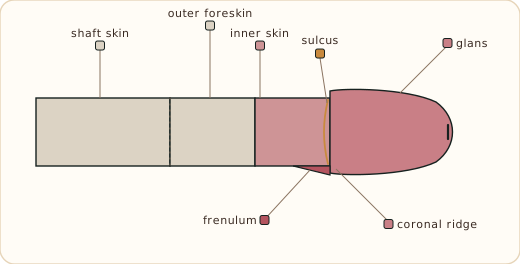
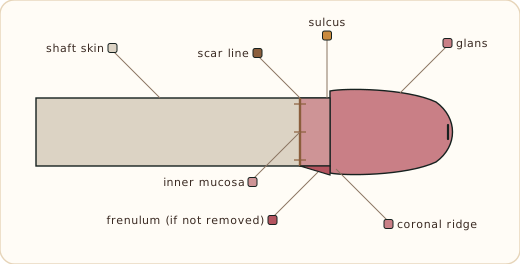
The rounded structure at the tip, sometimes called the head. Densely supplied with nerve endings and, in an intact penis, normally covered and kept moist by the foreskin. Its rim (the coronal ridge) is one of the more nerve-dense areas measured on the penis.
Shaft
The main body, running from the base to the coronal ridge. Covered in ordinary skin, with erectile tissue (the corpus cavernosum and corpus spongiosum) underneath that fills with blood during an erection.
Foreskin (prepuce)
A double-layered, movable sleeve of tissue covering the glans: ordinary skin outside, mucous membrane inside. Present at birth on every male; removed by circumcision where that happens. Covered in more detail below.
Frenulum
A small, sensitive, triangular fold on the underside of the glans, tethering the inner foreskin to the glans, circumcision sometimes removes the frenulum, if left it will be attached to the remaining inner skin) . Densely innervated, and frequently shortened or removed during circumcision.
Urethral opening (meatus)
The slit-like opening at the tip of the glans, where the urethra ends. Urine and, later, semen exit here.
Scrotum & testicles
Technically separate organs, not part of the penis itself, but anatomically adjacent and often asked about together. The scrotum is a skin sac; the testicles inside it produce sperm and testosterone, and the scrotum's muscle layer (the dartos and cremaster) adjusts to help regulate their temperature.
At rest, retracted, and circumcised
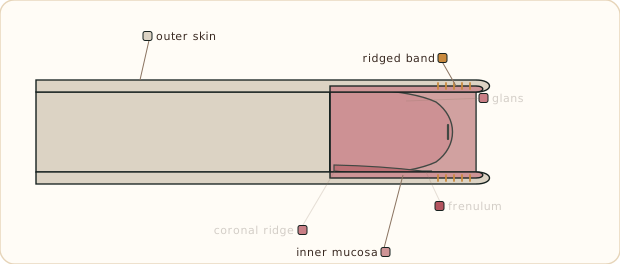
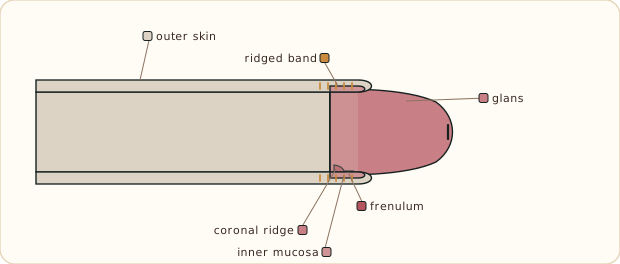
Front view and side profile, each shown three ways. Diagrams are schematic and not to scale.
Underside view
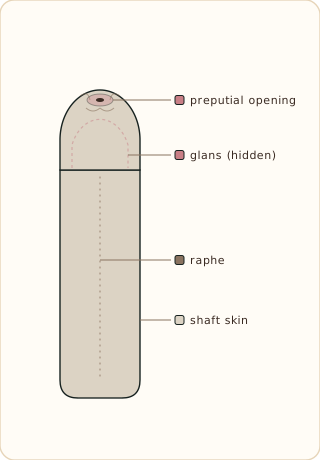
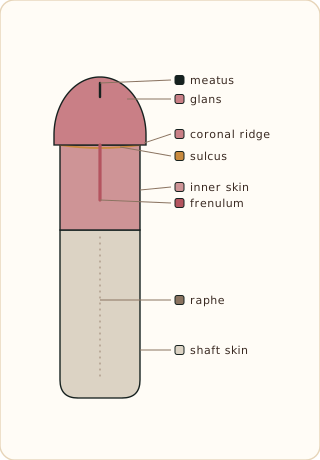
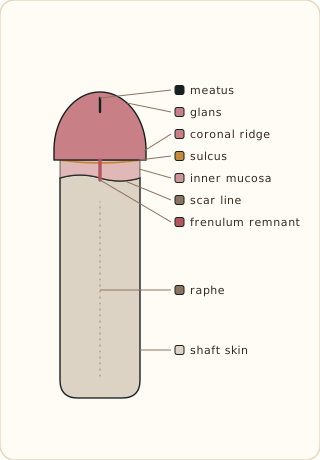
Side view
Shown narrower, one at a time — these are label-heavy diagrams that get hard to read squeezed into three columns.
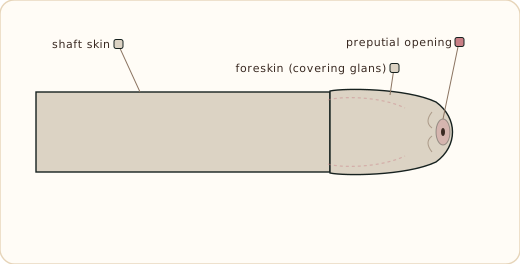
Gliding
The double-layer arrangement lets skin move against skin instead of relying on friction or stretch. Drag the slider, or let it play on its own.
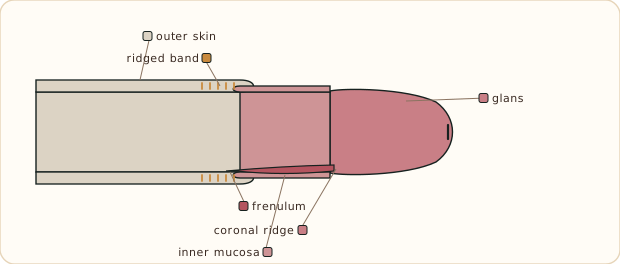
The foreskin is a double layer: ordinary skin on the outside, mucous membrane on the inside. It rolls rather than stretches, which is why the movement is called gliding. Diagram is schematic and not to scale.
The foreskin, covering the details
The foreskin is a double-layered sleeve of tissue that covers the glans. There's an outside surface and an inside surface, and they're made of different material.
The outer layer is ordinary skin, continuous with the skin of the shaft. The inner layer is mucous membrane — the same broad category of tissue as the inside of the lip or eyelid: thinner, moister, and not built for constant exposure to the outside world.
Because it's doubled over, the foreskin can roll rather than stretch. That rolling motion is called gliding — see it animated, step by step, under How it moves, above.
Outer layer
Regular skin, continuous with the shaft. Built for contact with clothing and the outside world.
Inner layer (mucosa)
Mucous membrane facing the glans. Thin and smooth, normally kept in a moist environment, and part of what keeps the glans itself moist rather than dry and keratinized.
The ridged band
A band of textured tissue where outer skin meets inner mucosa. First described in detail by Taylor and colleagues in 1996, who reported a concentration of Meissner's corpuscles there — nerve endings specialized for light touch.[1] How functionally important this band is remains genuinely debated in the literature.
The preputial opening
The ring at the tip. In infancy it's deliberately narrow, which is a normal, protective stage rather than a defect — it widens gradually, on its own schedule, usually well before puberty.
What the research measured
Sorrells and colleagues (2007) mapped fine-touch sensitivity across the penis using calibrated monofilaments, testing 19 sites in both intact and circumcised men. Several foreskin sites — including the ridged band and the rim of the preputial opening — ranked among the most sensitive measured.[2]
This page keeps that summary brief on purpose — the full study covers more sites and detail than fits here.
How much tissue is it?
Figures get quoted with more confidence than the evidence supports — estimates vary partly on whether the tissue is measured folded or unfolded.
The number repeated most often is roughly 30–50 cm² (about 4.6–7.75 sq in) for an adult foreskin, though it can run higher. The most directly relevant source is a 1998 study that dissected the prepuce as a surgical flap for reconstructive use. It found a mean of 46.7 cm² across cadavers, with real surgical specimens measuring as high as 90 cm² (about 14 sq in).[3][4]
A rough way to picture it: a standard 3×5 index card, flat, is 15 square inches (about 97 cm²) — near the high end of that measured range. Folded in half, the way a foreskin covers the glans in a double layer, it's a reasonably close comparison for an average adult.
The same 3×5 card from the paragraph above, ruled into 1-inch squares (15 of them), folded in half lengthwise, then wrapped around a plain circle standing in for the glans — sized so the fold's 5-inch edge just reaches once around it. Drag the slider. Schematic, not to scale.
Sources cited on this page
- Taylor JR, Lockwood AP, Taylor AJ. "The prepuce: specialized mucosa of the penis and its loss to circumcision." British Journal of Urology, 1996;77(2):291–295. The original description of the ridged band and its Meissner's corpuscles.
- Sorrells ML, Snyder JL, Reiss MD, et al. "Fine-touch pressure thresholds in the adult penis." BJU International, 2007;99(4):864–869. Semmes-Weinstein monofilament testing across 19 penile sites in 159 analyzed men (68 intact, 91 circumcised).
- Werker PMN, Terng ASC, Kon M. "The prepuce free flap: dissection feasibility study and clinical application of a super-thin new flap." Plastic and Reconstructive Surgery, 1998;102(4):1075–1082. Prepuce dissected and measured as a surgical flap: mean surface area 46.7 cm² across 8 cadavers, fully unfolded.
- Purpura V, Bondioli E, Cunningham EJ, et al. "The development of a decellularized extracellular matrix–based biomaterial scaffold derived from human foreskin for the purpose of foreskin reconstruction in circumcised males." Journal of Tissue Engineering, 2018;9:2041731418812613. Funded by Foregen Onlus Association; two authors are Foregen science advisory board members. States the adult foreskin has "a surface area of up to 90 cm², and potentially larger," citing Werker et al. above.